N.I.N.A. Session Analysis Handbook
Welcome to the N.I.N.A. Session Analysis handbook. This tool helps astrophotographers inspect, evaluate, and optimize their imaging sessions by analyzing files exported by N.I.N.A. and PHD2.
Main Purpose
The main purpose of this application is to analyze target capture quality, guiding performance, autofocus accuracy, and session overheads. By correlating FITS headers, N.I.N.A. logs, and PHD2 logs, it provides actionable insights to improve tracking, optics, and sequence configuration.
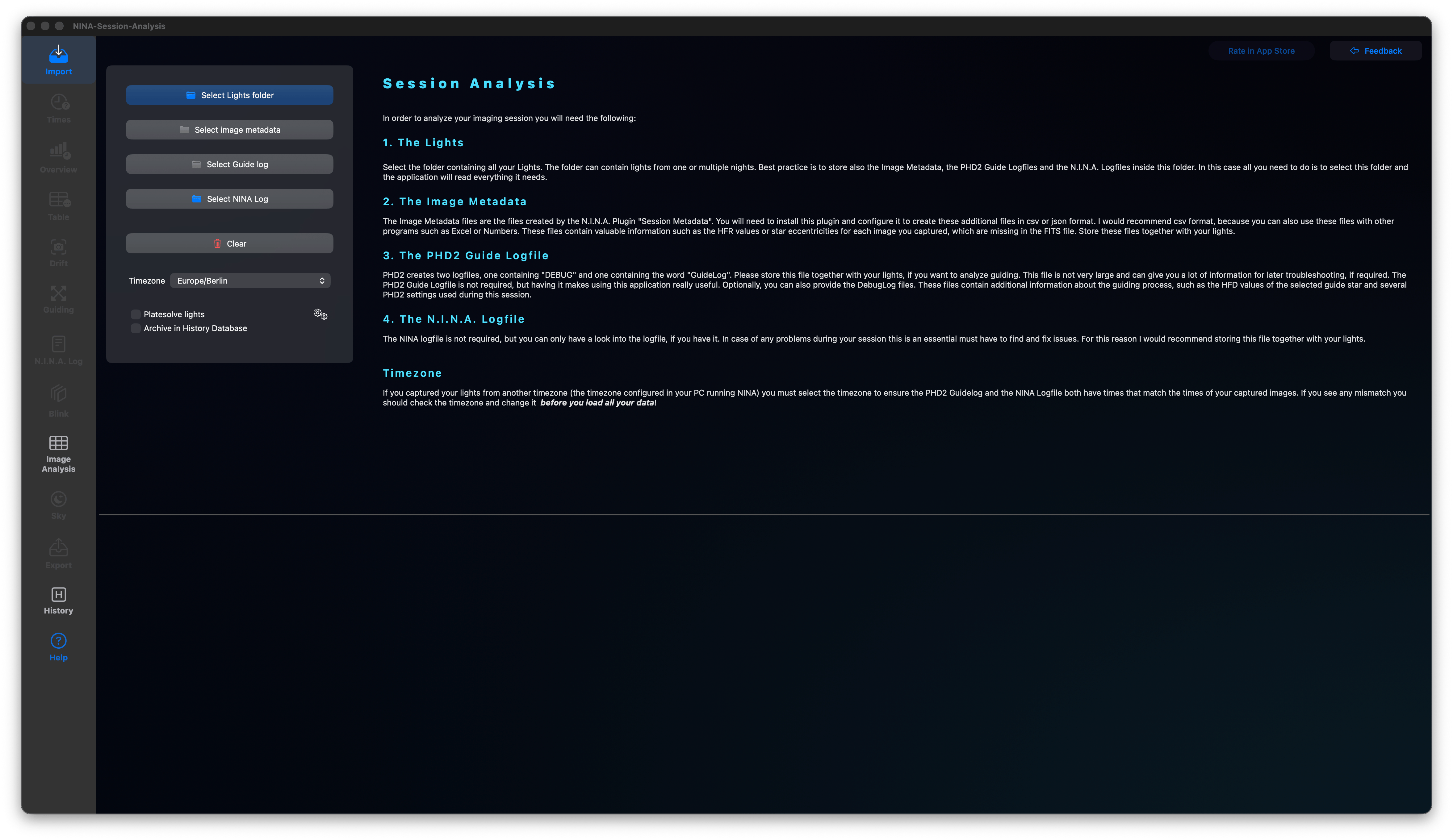
Required Session Files
For a complete analysis, group the following files in the same folder as your light frames (the application recursively scans subfolders):
- Acquisition Details (
AcquisitionDetails.csv): Generated by the N.I.N.A. Session Metadata plugin. Includes exposure settings and hardware data. - Image Metadata (
ImageMetaData.csv): Generated by the Session Metadata plugin. Maps each exposure index to HFR, star count, and sensor parameters. - Weather Data (
WeatherData.csv) (Optional): Captured by cloud sensors or local weather stations. - PHD2 Guide Log (
PHD2_GuideLog_*.txt): PHD2 guide statistics, calibration data, and drift calculations. - N.I.N.A. Session Log (
[YYYYMMDD]-*-[Version].log): The main session log file. Essential for mapping autofocus runs, exposure starts, and errors. - PHD2 Debug Log (
PHD2_DebugLog_*.txt) (Optional): If you want a more detailed analysis, using this file is recommended. You will get more information, i.e. the stars detected inside PHD2 and selected Guide Star with HFD values. - All Sky Keogram and or video (Optional): If you are using an All Sky camera, you can also manually add the keogram image. If available, it will be shown during analysis with a marker, so you can see inside the keogram, if there are some clouds.
Folder Structure
Single Night Session:
MyTarget_Night1/
├── AcquisitionDetails.csv
├── ImageMetaData.csv
├── WeatherData.csv (optional)
├── PHD2_GuideLog_2026-06-20.txt
├── 20260620-000102-NINA.log
└── Light/
    ├── Light_0001.fits
    ├── Light_0002.fits
    └── ...
Multi-Night Project Structure:
To analyze a target captured over multiple nights, place them in subdirectories (NIGHT_1, NIGHT_2, etc.) inside a master project folder. The app will automatically read them together:
MyProject_Target/
├── NIGHT_1/
│   ├── AcquisitionDetails.csv
│   ├── ImageMetaData.csv
│   └── Light/ ...
├── NIGHT_2/
│   ├── AcquisitionDetails.csv
│   ├── ImageMetaData.csv
│   └── Light/ ...
Of course, if you don’t like to use a folder structure like this, you can also load all files manually, but this structure will also help you to process your lights later in a software like PixInsight.
Glossary of Terms
| Term | Description |
|---|---|
| HFR (Half Flux Radius) | The radius of a circle around the bright center of a star containing half of the star's flux. Measured in pixels. Lower values represent sharper focus. |
| HFD (Half Flux Diameter) | The diameter of the circle containing half of the star's flux (approx. $2 imes ext{HFR}$). |
| FWHM (Full Width at Half Maximum) | The width of the stellar profile at half of its peak intensity. Indicates focus quality and atmospheric seeing. |
| Airmass | A measure of the amount of air the target's light travels through relative to the zenith (where airmass = 1.0). Higher airmass = lower target altitude = worse seeing. |
| Azimuth & Altitude | Horizontal position (angle from North) and vertical position (angle above the horizon) of the target. |
| Pierside | Indicates whether the German Equatorial mount is on the East or West side of the pier, determining whether a Meridian Flip has occurred. |
| Eccentricity | Measures star roundness. Perfect circles have an eccentricity of $0$. Acceptable values are usually below $0.5 - 0.6$. |
| ADU (min/max) | Analog Digital Units. Represents pixel brightness values. ADU (min) should stay above 0 (and above camera offset) to ensure images are background-limited. |
| RMS (Root Mean Square) | Standard deviation of guiding tracking errors in arcseconds. Should ideally be smaller than your imaging pixel scale. |
| e RMS | A calculated eccentricity estimate based on the ratio between Right Ascension (RA) and Declination (Dec) RMS guiding deviations. |
| Delta Temperature | The difference between sky temperature and ambient temperature (often used to detect cloud cover). |